
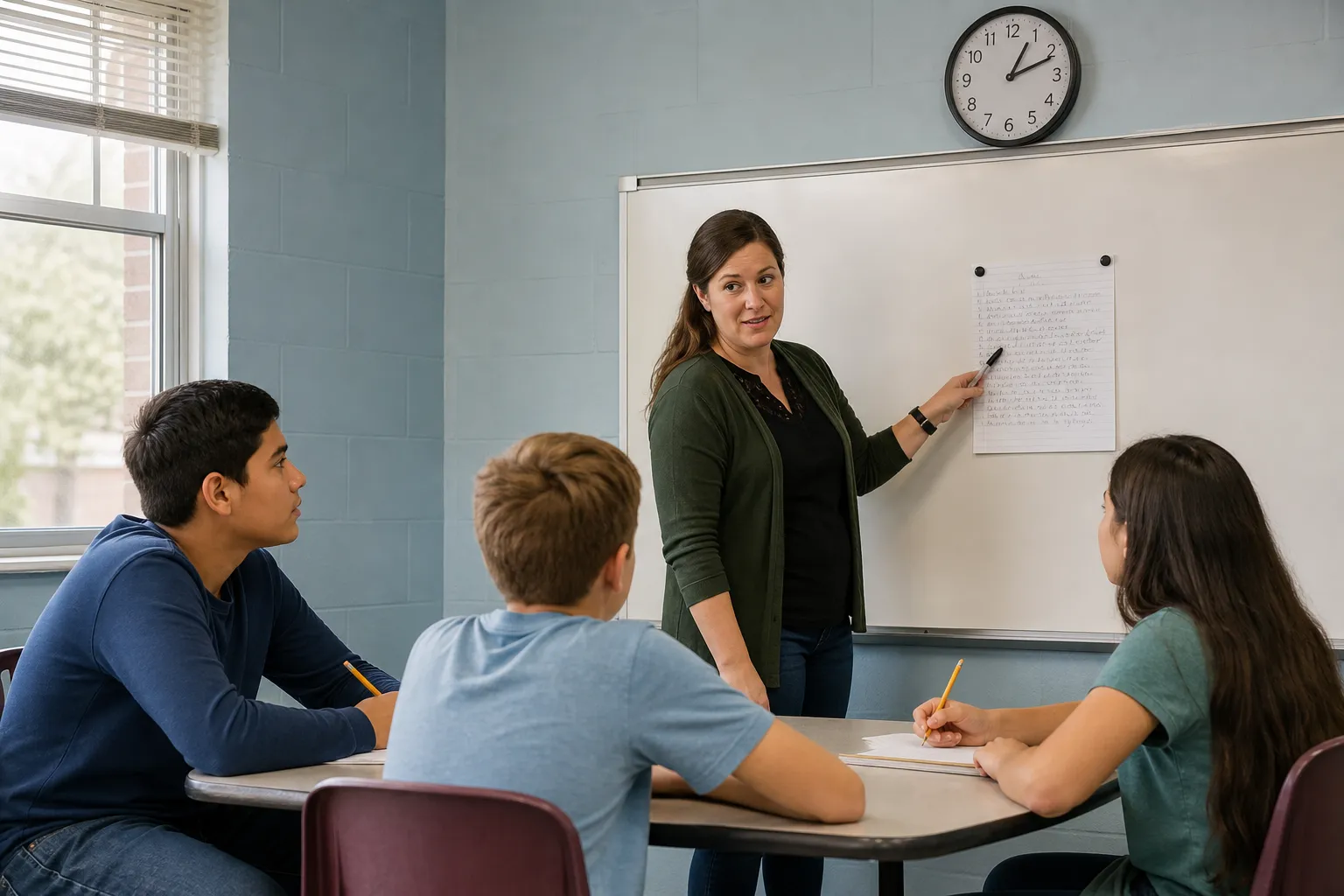
A substitute teacher can turn an ordinary school morning into an information-gap day: a familiar room may look the same, but the person leading it, the order of activities, and the answers to small questions may be less predictable. A substitute teacher social story can help a child and trusted adults name that gap without presenting the child’s reaction as a problem to fix. This guide is for parents, carers, and educators who want to prepare together for a possible teacher absence, whether the school uses the term substitute teacher, guest teacher, relief teacher, or supply teacher. It is not a promise that the day will feel easy or run exactly as planned. Instead, a personalised social story can describe what is known, acknowledge what may be different, and make room for the child’s own preferences, questions, and ways of responding.
Why a substitute teacher can feel like more than a different adult
For some children, a substitute teacher is simply a new person at the front of a familiar classroom. For others, the change may affect many small parts of the day at once. The usual teacher may know how the child communicates, how they like instructions phrased, what makes a joke confusing, whether they prefer time before answering, or which routines matter most to them. A substitute may be kind and capable while not yet knowing those details. The uncertainty, rather than the substitute teacher personally, may be what feels demanding.
This can be particularly relevant for some autistic children. Autism is a broad neurodevelopmental variation, and autistic people have varied communication styles, sensory experiences, interests, needs, and strengths. It is not accurate to assume that every autistic student dislikes unfamiliar teachers or needs the same preparation. Still, some autistic children may notice changes in voice, expectations, seating, classroom language, timing, or social rules very quickly. A teacher change can also mean having to decide whether, when, and how to explain a need to someone unfamiliar.

A child may also be concerned about practical questions that adults might not think to answer: Who will take attendance? Will the class still go to art? Can I ask to use the bathroom in the usual way? What happens if I do not understand an instruction? Will my regular teacher return tomorrow? These questions are reasonable. A useful substitute teacher social story does not dismiss them with reassurance alone. It gives accurate information where it is available and clearly separates facts from things that are not yet known.
Autism, anxiety, and transitions: possible experiences without assumptions
A change of teacher can intersect with autism, anxiety, and changes-and-transitions in different ways. Some autistic students may find it harder to interpret an unfamiliar adult’s facial expressions, indirect directions, humor, volume, or expectations. Others may be comfortable with the new adult but unsettled if familiar routines are altered. Some may enjoy the novelty, appreciate a different teaching style, or be curious about the visitor. Individual experience matters more than a label.
Anxiety can involve worry, physical discomfort, repeated questions, difficulty concentrating, irritability, avoidance, or a strong wish for certainty. Those experiences can have many causes, and a worried response to a substitute teacher does not by itself indicate an anxiety condition. The Centers for Disease Control and Prevention’s information on anxiety and depression in children emphasizes that children’s mental health concerns can look different across individuals and may affect school, home, or friendships. Families who are concerned about ongoing distress can use their usual school and healthcare channels for individual guidance; a social story is not an assessment or treatment.
Changes and transitions can be challenging even when the change is temporary and positive. The transition begins before the substitute arrives if a child hears about the absence, and it may continue afterward while they process what happened. A personalised story can include the possibility that plans may change again, such as the regular teacher returning sooner or later than expected. Honest wording is important: it is better to say that adults will share an update when they have one than to guarantee a particular outcome.
What a personalised substitute teacher social story can cover
A social story is most useful here when it is specific to one child, one school, and a realistic situation. Rather than trying to teach broad compliance, it can organize information and reduce guesswork. The story may identify the familiar setting, explain that a regular teacher can sometimes be away, and state who may lead the class that day. If the school knows the substitute’s name or the expected length of the absence, those details can be included. If it does not, the story can say so plainly.
It can also distinguish between what will probably stay the same and what could be different. For example, the classroom, classmates, lunch period, and some lessons may remain familiar, while the adult’s voice, way of giving directions, or sequence of work may differ. Avoid stating that a routine will definitely happen unless the family or school has confirmed it. This protects trust when an assembly, weather event, staffing need, or other ordinary school change affects the plan.
The child’s perspective belongs in the content. A family might include their preferred name for the event, questions they often ask, parts of the day they care about, and what they want adults to know. The story can name several possible feelings, including okay, curious, disappointed, frustrated, worried, or unsure, without predicting one response. It can also identify familiar people the child may see, if that information is accurate. Example sentence only: “A different teacher may be in my classroom today.” This is a content example, not a complete social story.
Preparing together before the school day
When there is advance notice, preparation can be a shared conversation rather than a last-minute explanation. A parent, carer, educator, and child may compare what each person knows. Adults can be direct about the limits of that knowledge: the regular teacher may be absent for one day, several days, or an unknown period; the classroom may have a particular substitute, or the school may still be arranging cover. Giving a child false certainty may make a later change harder to understand.
A child can help decide what belongs in their personalised social story. Some may want the substitute’s name and a brief factual description. Some may care most about lunch, transportation, a specialist class, or who will be at arrival. Some may prefer not to discuss a change repeatedly. They might want to ask a question in advance, write down a concern with an adult, speak to a familiar school staff member, or simply receive the information once. These are possible preferences, not requirements.
Family routines may provide a steady reference point during a school transition. The American Academy of Pediatrics discusses the importance of family routines, while also recognizing that routines can support connection and predictability. In this context, a familiar breakfast, departure sequence, after-school check-in, or bedtime rhythm may remain unchanged even if school feels different. No routine guarantees a particular emotional response, and families can adapt the conversation to the child rather than forcing a fixed format.
Writing with accuracy, dignity, and room for choice
Use concrete, respectful language. Say “substitute teacher,” “supply teacher,” or the term the child’s school uses, then explain it in plain terms. Avoid language that frames an unfamiliar adult as dangerous, a child as disruptive, or a successful day as one in which the child hides distress. Similarly, avoid promises such as “Nothing will change,” “I will not be worried,” or “The substitute will know exactly what to do.” Such statements may not be true and can make a child feel they have failed if they do feel worried or if the day changes.
A story may describe choices as possibilities when they are genuinely available in that setting. Depending on school practice and the child’s preferences, they may be able to listen first, ask for an instruction to be repeated, tell an adult they are unsure, wait until a quieter moment to ask a question, or speak with a familiar staff member. Do not insert any option merely because it sounds helpful; confirm that it is realistic for that child and school. Example sentence only: “If I am unsure, I may be able to ask a question.”
Keep the focus on information and self-understanding, not behavior control. The child does not need to be taught to welcome a change, make eye contact, speak in a particular way, or appear calm. They may communicate comfort or discomfort through speech, silence, movement, writing, gestures, or another established method. If adults share information with a substitute teacher, it should be limited to what is relevant, respectful, and appropriate to share. The child’s privacy and voice should be considered whenever possible.
After the substitute day: learning from what actually happened
A brief follow-up can make the next teacher change more understandable. The goal is not to quiz the child or insist on a positive review. An adult might offer a low-pressure opportunity to share what was the same, what was different, what was surprising, and what information would have been useful beforehand. The child may not want to discuss it immediately, and that preference can be respected. Their account may also differ from an adult’s observation, especially if they worked hard to get through a demanding day.
Update the social story only with details that improve accuracy. Perhaps the child learned that the substitute used different words for a familiar activity, that the regular teacher’s return date was uncertain, or that a particular part of the day stayed unchanged. Perhaps the anticipated difficulty did not occur, while a different transition was harder. This reflection prevents the story from becoming a generic script and helps it remain a truthful preparation resource for future absences.
For context, the Centers for Disease Control and Prevention’s autism spectrum disorder information notes the wide variation in autistic characteristics and support needs. That variation is a reason to individualize rather than rely on assumptions about a child’s diagnosis. A substitute teacher social story cannot control staffing or remove every uncertainty. Its value is that it can help a family and school speak honestly, anticipate questions, and recognize that a child can have their own valid response to a temporary change.
Frequently asked questions
What is the difference between a substitute teacher social story and an autism substitute teacher social story?
The core topic is the same: preparing for a temporary change in who leads the class. An autism substitute teacher social story should not assume that all autistic children respond alike. It can be personalised around that particular child’s communication style, priorities, known information needs, and school context. The most useful details may be entirely different from one autistic child to another.
Should a substitute teacher social story say that the child will be calm or that everything will be normal?
Usually, no. A story is more trustworthy when it does not predict feelings or guarantee outcomes. It can acknowledge that the child may feel many different things and that some routines may remain the same while others may change. If an important detail is unknown, it is more accurate to say that an adult will share an update when available.
Can this guide be used for a supply teacher social story?
Yes. “Supply teacher” is commonly used in some school systems for a teacher covering an absence. Use the term that the child, family, and school recognize. The key is to describe the actual situation: whether the teacher is expected for one lesson, a day, or longer, and which parts of the day are confirmed versus uncertain.
Keep exploring
Related social stories
These guides cover situations with similar routines, sensory details or preparation needs.


Learn more about writing a social story
Read what a social story is, follow the step-by-step writing guide, or browse more social story examples.
Sources
- Autism spectrum disorder — Centers for Disease Control and Prevention
- Anxiety and depression in children — Centers for Disease Control and Prevention
- The importance of family routines — American Academy of Pediatrics
